Event-Driven Business Reviews
Your Business Runs on Free Jazz, Not a Metronome — So Why Are You Still Reviewing on the Beat?

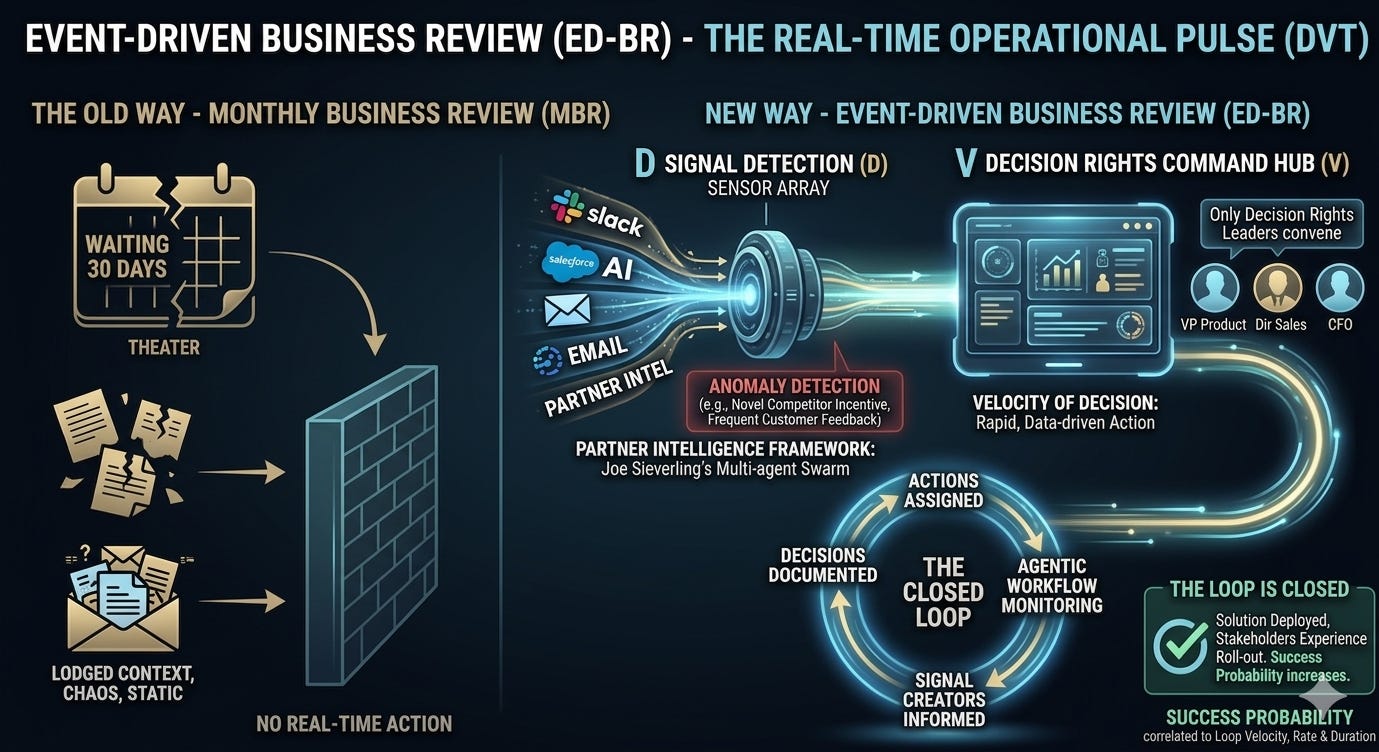
My colleague Rahul Pathak’s post on DVT (Data, Velocity, Time) really got me thinking. Specifically, the fact that what we like to call the “Rhythm of the Business” isn’t the rhythm of the business at all. We all snap to some regular time-bound review cycle – weekly, monthly, quarterly – yet that’s not how events actually unfold. If we put our ears to the ground, you’ll hear a very different rhythm. One that’s more free jazz than four on the floor. I have some ideas on how to tune into that flow. And, as Rahul says, close the loop faster.
I mean, I get it. Public companies report earnings quarterly. Private companies are accountable to their investors. So, it makes sense to have sales and output-oriented reviews on a regular basis that ladder up to those quarterly reports. And sure, regular checkpoints create accountability. But too often these reviews regress to a kind of theater. Lots of people reviewing lots of content and lots of data with very few decisions being made and even fewer actions taken.
It’s time we move toward what my team calls event-driven business reviews (or ED-BRs.) We’ve had event-driven architectures for a while. Similar concept. At any given moment, there are hundreds, if not thousands, of meetings, conversations, customer and partner interactions, observations, learnings, and decisions being made across the business. A lot of it is noise. But look — listen close enough and you’ll hear it. A rhythm emerging. A competitor offering a novel commercial incentive that’s piquing your customers’ interest. Customer feedback on a product feature, not from just one customer but from dozens. A positioning strategy that’s resonating with customers in unexpected ways across industries or geographies.
This is the “D” (Data) in Rahul’s DVT. The challenge has been that so much of this rich context has been either lodged between people’s ears or shared in random Slack messages, emails, trip reports, and notes scribbled in Moleskins with various corporate logos on their fronts. That Moleskin scribble is still a problem, but the rest is not so much. On my team, we’re using Amazon Quick in concert with an AI-powered tool in our Salesforce instance plus what we call our Partner Intelligence Framework – a multi-agent swarm built and maintained by Joe Sieverling – to hone in on the frequency, tune out the static, and pick up what our business is putting down.
Ok, great. We have the signal but something anomalous is happening in the business — good or bad — and we need to act. This is the “V” (Velocity) in DVT. Rahul talks about closing the loop, and that’s exactly right. It’s like Stephen Stills sang way back when, “There’s something happening here, but what it is ain’t exactly clear.” The longer it ain’t clear, the bigger the problem. We can’t wait for the next MBR. Instead, using the Partner Intelligence Framework plus Amazon Quick, we can now understand the context of this anomaly, and based on that, identify the right leaders in the org to convene, dive deep, debate, make decisions, and take actions. We’re even getting to the point where our tools suggest the right leaders and handle the invitation. Just those with decision rights. No more.
We still haven’t closed the loop though. We do that when all the decisions are documented, the actions are assigned, an AI-powered workflow is keeping tabs on those actions, and the folks who flagged the issue or opportunity in the first place are informed that it’s being addressed, by whom, how, and in what time-frame.
Hmm. The loop still doesn’t feel quite closed. When the issue is solved or a new initiative has been created to address the opportunity, and all those stakeholders – including those original signal-creators – experience the roll-out of the fix or new program and can introduce it to their partners and customers, then the loop is closed. And the rate at which we can close the loop, and the number of loops we can spin up and close, and the longer we can sustain it — that’s the “T” in Rahul’s DVT — will be directly correlated to the probability of our success.
And for my smallish team, the way we’re chipping away at it is via event-driven business reviews. Time is the real differentiator. Not calendar time — cycle time. How fast can you detect, convene, decide, and close? Most organizations measure themselves in quarters. We’re trying to measure ourselves in loops. The faster you spin them, the more you learn. The more you learn, the better your next decision.
We’re early. But the gap between teams that figure out how to compress that cycle and those still waiting for the next QBR to surface a problem from six weeks ago — that gap is only going to widen.
Absolutely loved the music analogies as a former musician! Never thought I’d get clarity relating AI to avant garde jazz. Sun Ra would be proud.