Everyone is a Librarian
Why everyone on my team is now a librarian, and what that means for how we build, share, and trust knowledge in the age of AI agents.

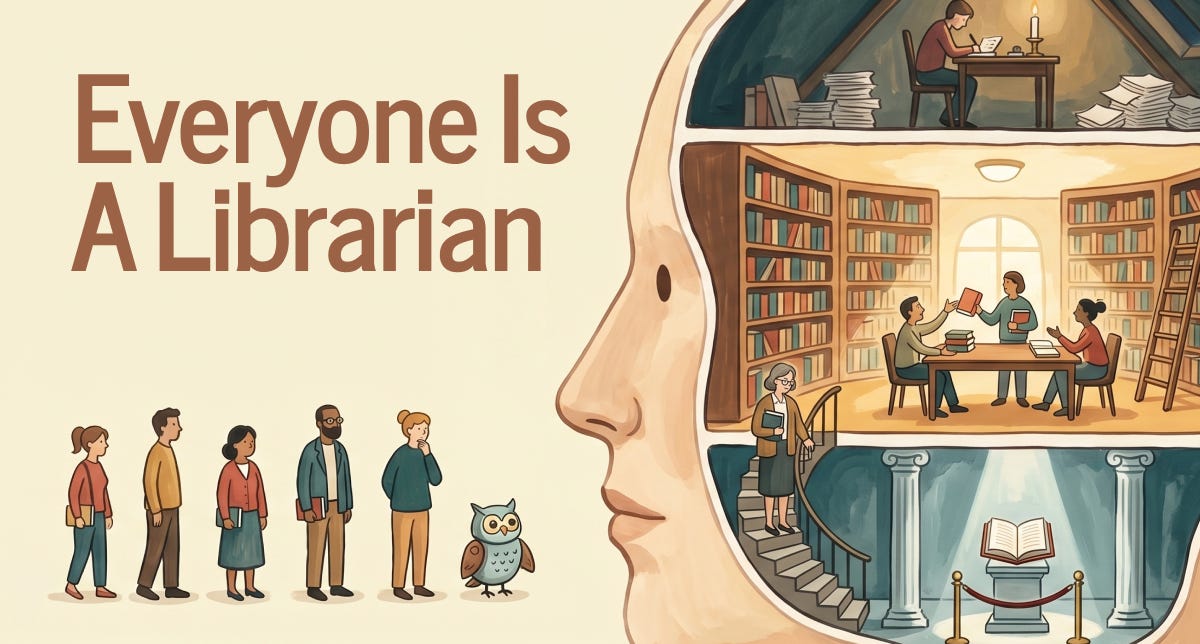
My extended team of business and technical folks have been using Amazon Quick Suite and Kiro for several months to drive efficiencies, enable collaboration, automate workflows, and build new capabilities. We’re getting a lot done, more than I once thought possible, but the interesting thing is the conversation we’re having about how we need to work differently, maybe organize differently around projects, and how best to share and build knowledge at the individual level, across teams, and throughout the entire org.
Today I’m going to focus mostly on the knowledge building, curating, and sharing bits. And because apparently you can’t write an essay on these topics without providing some historical context, allow me to get a bit historical-philosophical for a moment. Begging forgiveness from actual scholars.
If you think about the natural state of knowledge…call it, knowledge at rest… it is 100% distributed across about 8 billion human brains. Everything that’s ever been created to harness, preserve, and share that brain-contained knowledge since the beginning of time has just been a series of inadequate means to what I think is a pretty noble end: a perfect and organically shared consciousness. Woah. Yeah, told you. But wait. Not talking about the hive mind from Pluribus though. No, I’m thinking of a model where any human can choose to preserve their private thoughts and knowledge, while deliberately deciding what to curate and make available to a broader set of people. And then for any human participating in that consciousness or network of knowledge to be able to tap into it at their discretion.
Up till this century, the big friction point has been the physical act of curating, sharing, and compiling all this knowledge. For eons the oral tradition was the means through which culture, history, knowledge – context – spread. Through the telling the stories evolved and probably were only as good or as reliable as the teller. Not exactly canonical. Then, for centuries it was mostly monasteries and libraries like the House of Wisdom in Baghdad that preserved knowledge, but that was obviously a very stringent curation process and limited by how much human hands could transcribe. Then comes the Gutenberg Bible, loosening the creation and distribution bottleneck, to an extent, up through until the Internet blew knowledge creation, sharing, and distribution wide open.
So why the dilettante’s trip through the abridged history of knowledge sharing? All to make the point that with tools like Amazon Quick on everyone’s desktop I think we’re getting ever closer to the noble goal of curating our own personal knowledge stores, or graphs, or what I like to think of as libraries, while at the same time building and running ambient curation workflows that allow us to share out portions of those libraries – what Greg on my team calls knowledge droplets – safely and securely to targeted audiences and teams.
This is why I tell everyone on my team that they are now a librarian.
What I Mean by Librarian
The mental model is based on the original function — someone who curates a body of knowledge, maintains its integrity, decides what belongs and what doesn’t, and creates the conditions for others to find what they need.
Think about what a great librarian actually does. They don’t just shelve books. They organize knowledge so that it’s discoverable. They know what’s in the collection intimately — not because they’ve memorized every page, but because they understand the relationships between ideas. They make judgment calls about what to acquire, what to archive, what to surface. They serve as the interface between a body of knowledge and the people who need it.
That’s the job now. For all of us.
Every industry or domain expert, every partner manager (my world), every initiative lead, every specialist — the role is evolving from “person who fields questions, does the work, and reports on it” to “person who curates the knowledge in their domain, creates an intelligent front door for others to access it, and then, with this collective intelligence established, gets the work done.” This is a big shift. Speaking for myself, I know a lot of my value and organizational currency over the years has derived from the fact that I know stuff. That when folks come to me, I can generally answer their questions or point them in the right direction. I also know that I struggle to keep it all straight and would rather spend that time diving deep with my colleagues to solve some hard problems by pulling from, and contributing back to, a base of shared know-how. Without spending a ton of time actively managing that shared corpus. Brings me back to the librarian.
The librarian doesn’t perform this function alone; they are aided by an AI-powered curation expert that is constantly learning about the way they work and make decisions. The librarian builds the rules around what gets shared, with whom, and at what level of confidence; the AI refines those rules and constantly pressure tests them. That initial curation — that judgment — is critical; it’s the high judgment call based on one’s sense of what matters. The AI-powered curator then runs a looping workflow over all the librarian’s knowledge and content, using those rules to determine how best to organize and share knowledge.
Three Libraries, Not One
Here’s where it gets interesting. When I started thinking about this pattern, I realized it’s not one library. It’s at least three, for everyone on the team. And the relationship between them is where the architecture lives.
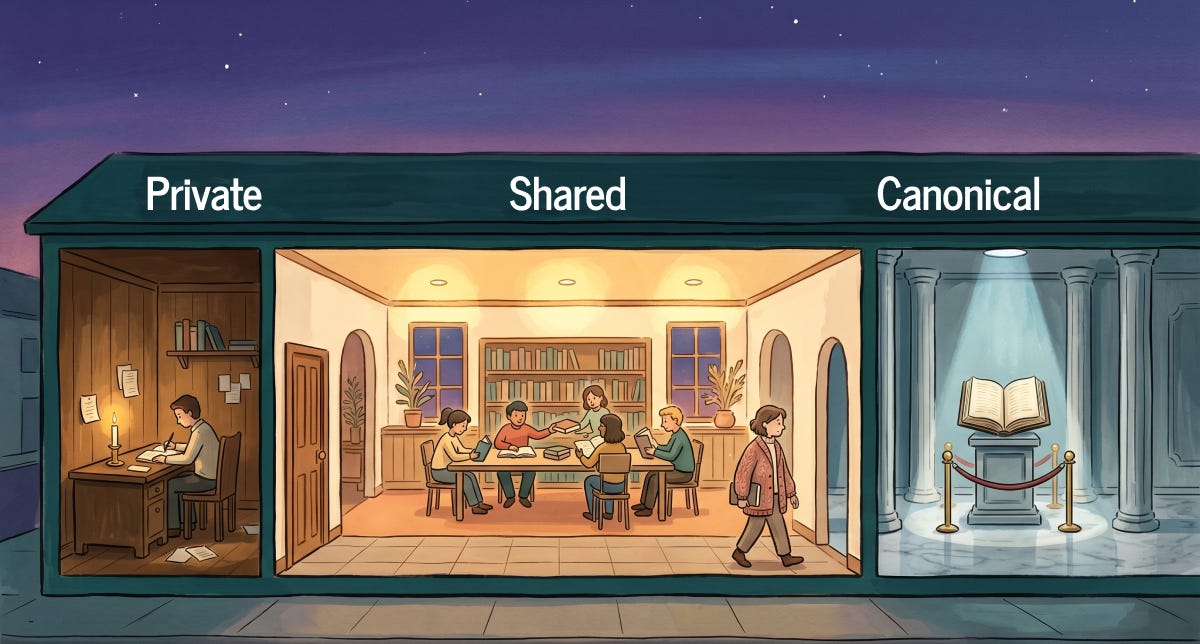
The Private Library. This is your personal knowledge. Your working notes, your meeting context, the deal details only you should see, the half-formed hypotheses you’re not ready to share. Your tribal knowledge. The stuff that, today, lives in your head or scattered across your notes and email. A librarian curates this — decides what stays private, what gets promoted to the shared collection, what’s still too raw to circulate. This is the sanctum.
The Shared Library. This is where contributed knowledge compounds. Think of it as a reading room. Your team’s collective intelligence — observations from the field, patterns spotted across engagements, frameworks that emerged from real work. Here’s the important thing: knowledge in the shared library isn’t official. It’s contributed. It’s useful and true, but it hasn’t been canonized. It’s someone saying, “I saw this pattern with three different partners last quarter” — valuable signal, not yet gospel. This is also where cross-functional initiative teams whose missions may be ephemeral converge, contribute, run their own curation agents against, and execute. In just a short time we’re seeing a step change in how these teams can move at pace when not wading through Slacks, emails, and Zoom calls where the context is too often lost to the wind. I’ll probably develop this more in another post.
The Canonical Library. This is the reference section. Official frameworks. Approved methodologies. Certified content. SOPs. The knowledge here isn’t just true — it’s been stamped. It’s immutable until deliberately updated through a governed process. When an agent queries the canonical library, it can act on what it finds with high confidence because someone — a librarian — has done the work of vetting, validating, and approving it. Whatever you used to put on a wiki or in some kind of official knowledge repo. You know…the ones with all the slide decks with slightly different names that you have to wade through? The new model is having a tool like Quick nearly instantly create your deck by pointing it at the canonical library.
The magic isn’t in any single layer. It’s in the flow between them. An individual spots something interesting in their private library — a pattern, a datapoint, a friction they keep seeing. They contribute it to the shared library. Others see it too. The observation compounds. And when a librarian — a domain expert with both the authority and the context — sees a pattern emerge ten times, they don’t just note it. They canonize it. They create the definitive version. The value map. The framework.
See a pattern once? It’s interesting. See it five times? It’s a signal. See it ten times? Create the canonical asset. That’s the librarian’s job.
Why This Matters Now
You could argue organizations have always needed better knowledge management. Fair. But two things make this urgent in a way it’s never been before.
First, agentic AI is the forcing function. When agents operate across your organization — querying knowledge, taking actions, making recommendations — the quality of the knowledge architecture is the quality of the output. Bad libraries don’t just mean inefficiency anymore. They mean confidently wrong answers at scale.
A colleague of mine, Karthik Sonti, put this perfectly. He pointed out that a seemingly simple KPI like “warehouse performance” can mean completely different things to Operations versus Finance. Same words, different definitions, different data sources, different implications. When a human asks about warehouse performance, context resolves the ambiguity. We know who we’re talking to, which meeting we’re in, what we were just discussing. We pattern-match our way to the right interpretation without even thinking about it.
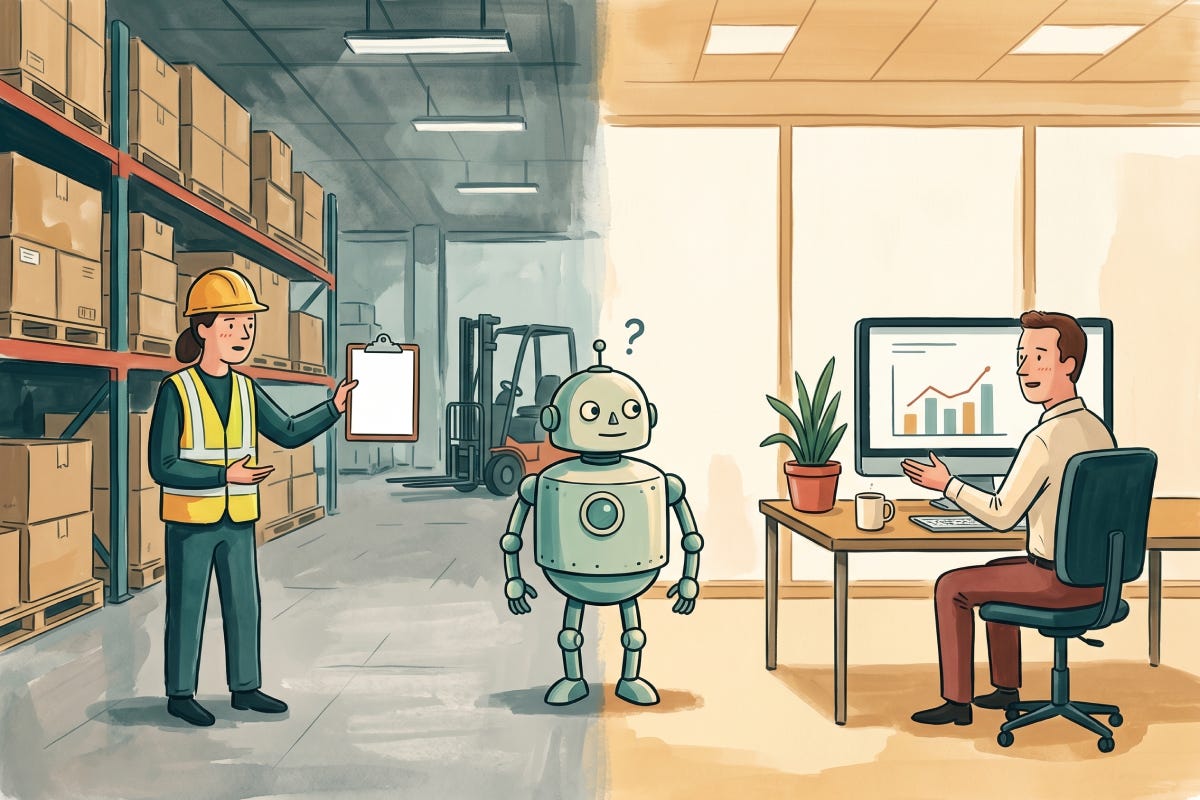
An agent doesn’t have that luxury — unless we build the architecture to provide it. Without semantic stewardship — someone actively curating what terms mean in which domains — you get agents confidently delivering the wrong answer to the right question. At speed. At scale. With a reassuring tone.
That’s not an efficiency problem. That’s a trust problem. And trust, once lost in an agentic system, is very hard to rebuild.
Second, the new ways of organizing work. Lots of talk on this topic lately, especially after the From Hierarchy to Intelligence essay by Jack Dorsey and Roelof Botha. They definitely got me thinking, as did Andrej Karpathy’s LLM Knowledge Base architecture, although setting that up was a bit beyond my capabilities. But frankly, the biggest inspiration has been diving in with Quick and riffing with my team on what this all means and how might we create a better model. And this has led me to more of a bottoms-up approach mental model, versus the more tops down world model espoused by Dorsey and Botha. I just don’t think that’s viable at scaled enterprises. Nor desirable. Don’t see a world where my knowledge graph would, or should, overlap and interface with that of a category manager on the retail side of the business. Maybe I’m wrong, but don’t think the juice would be worth the squeeze, even notwithstanding the security and access challenges. In any case, I do think that which knowledge spaces you subscribe to defines your information diet every bit as much as where you sit in the org chart. The question won’t just be “who do you report to?” but also “which libraries does your agent have access to?” And, to my point above, in a world where so many of us are working on so many cross-team initiatives, this knowledge sharing mental model just memorializes the existing reality.
The Governance Question: Not Top-Down OR Bottom-Up
Easy to get stuck here, but it’s just another false dichotomy.
One camp says knowledge governance should be top-down. Central authority. Controlled taxonomies. Everything approved before it enters the system. The problem? It doesn’t scale. It kills velocity. And it misses the most valuable knowledge — the stuff that emerges from the edges, from the people doing the actual work.
The other camp says let it be organic. Bottom-up. Let people share freely and let the cream rise. The problem? You end up with a thousand conflicting definitions, no quality control, and agents that can’t distinguish between someone’s half-baked meeting note and an approved methodology.
The answer, as is often the case, is both. And neither. It’s the librarian model.
The human judgment about what to share and when is bottom-up. No central authority is going to tell a domain expert which of their observations are ready to be contributed. That’s a judgment call born from expertise and context. But the system-level enforcement of roles, permissions, and canonical authority is top-down. Not everyone gets to stamp something as canonical. Not every observation belongs in every library. The architecture provides the structure; the librarians provide the judgment.
This is the pattern I keep coming back to: AI augmented human curation within system-enforced guardrails. It’s not governance by committee and it’s not governance by algorithm. It’s governance by trusted domain experts with the right tools and the right boundaries.
And here’s another insight from Karthik that applies: earned autonomy. You don’t give an agent full run of the entire knowledge architecture on day one. You start in domains where you have end-to-end visibility. Where you can see the inputs, the outputs, the decisions being made. You build trust. You expand scope. The librarian and agents earn autonomy by demonstrating good judgment in increasingly complex territory.
The same is true for libraries. Start with your domain. Curate it well. Let the quality of your library earn the trust that expands its influence.
What This Looks Like in Practice
I’ll give you a real example.
We recently had a strategic meeting with a major global partner. Happens all the time with senior leaders from both sides, deep discussions about joint initiatives, and a mix of sensitive deal details and broadly applicable methodologies. In the past, the meeting notes would go into someone’s inbox, get forwarded to a few people, and the insights would slowly diffuse — or, more often, quietly die.
This time, something different happened. The meeting transcription was immediately captured and, almost immediately, the knowledge was classified. Sensitive deal details (the specific numbers, the named accounts, the commercial terms) stayed in the private library. Not shared. Appropriately protected.
But the methodology that emerged — a “factory approach” to scaling agentic deployments — got recognized as something bigger than one deal. It was contributed to the shared library. Other team members saw it, added their own observations from similar conversations, and within days the framework had been enriched by multiple perspectives.
That’s the library system working. Private knowledge stays private. Shareable frameworks get shared. The AI-powered, rules-based curation workflows created by the librarians, the domain experts who were in the room, made the judgment calls about what belonged where. No committee. No approval workflow that takes three weeks. Human judgment, AI accelerated.
The really powerful part? Next time someone (or some agent) needs to understand best practices for scaling partner-led agentic deployments, the canonical version is there. It didn’t come from a top-down directive. It emerged from practice, was curated by the people closest to the work, and was promoted through the layers by human judgment.
What I’d Do Monday Morning
If this resonates, here’s where I’d start.
Identify your librarians. They’re already there. They’re the people on your team who others go to when they need to understand something. The person who “just knows” how that process works, or why that partner does things a certain way, or what happened in that meeting last quarter that changed everything. Those people are already curating knowledge — they’re just doing it informally, inefficiently, and invisibly. Name the role. Make it explicit.
Make sure these librarians have access to and are eager to adopt and learn the latest AI tooling. This is not manual. AI is required to build the knowledge graphs that constitute the libraries, and to run the rules-based curation workflows to classify content. And then to continually run those workflows as loops. And to be clear, I’m saying start with the eager, but didn’t name this post Everyone is a Librarian for nothing.
Define the three layers. What’s private? What’s shared? What’s canonical? You don’t need a perfect taxonomy. You need a shared understanding that these layers exist and that promoting knowledge between them is a deliberate act, not an accident.
Start with one domain. Don’t try to build the Library of Alexandria on day one. Pick a domain where you have strong expertise, clear boundaries, and end-to-end visibility. Curate it well. Build the pattern. Be conservative. Let it earn trust. Then expand.
Ask the context question. For every piece of knowledge that enters your system, ask: will an agent be able to use this correctly? Does it carry enough context to resolve ambiguity? Or will it generate confident wrong answers because the same term means different things in different domains? If you can’t answer that, you have a semantic stewardship problem, and no amount of technology will fix it.
Give your libraries a front door. This is the agent layer. The interface that lets others — human or machine — query your curated knowledge appropriately. The librarian doesn’t just maintain the collection. The librarian creates the conditions for discovery.
The technology to build these knowledge layers exists today. The agents that can query, reason, and act on well-curated knowledge are here. The missing piece isn’t the tech.
The missing piece is the librarian.
What does the librarian role look like in your organization? Who’s already doing it without the title? I’d love to hear — drop a comment or reach out directly.
Brian Bohan is Director of Worldwide Consulting Partners at AWS, where he leads the Consulting Partners Center of Excellence. He previously founded and scaled the Accenture/AWS Business Group to over $1 billion across 14 countries. He lives in New York City, where he’s been since 1993.